












Shock and awe: Law firm leaders react to a tumultuous legal and regulatory environment
The year 2025 has ushered in an unprecedented legal landscape, where challenges to long-standing rules and regulations are happening with breakneck speed and uprooting traditional alliances across businesses, governments, and global allies.
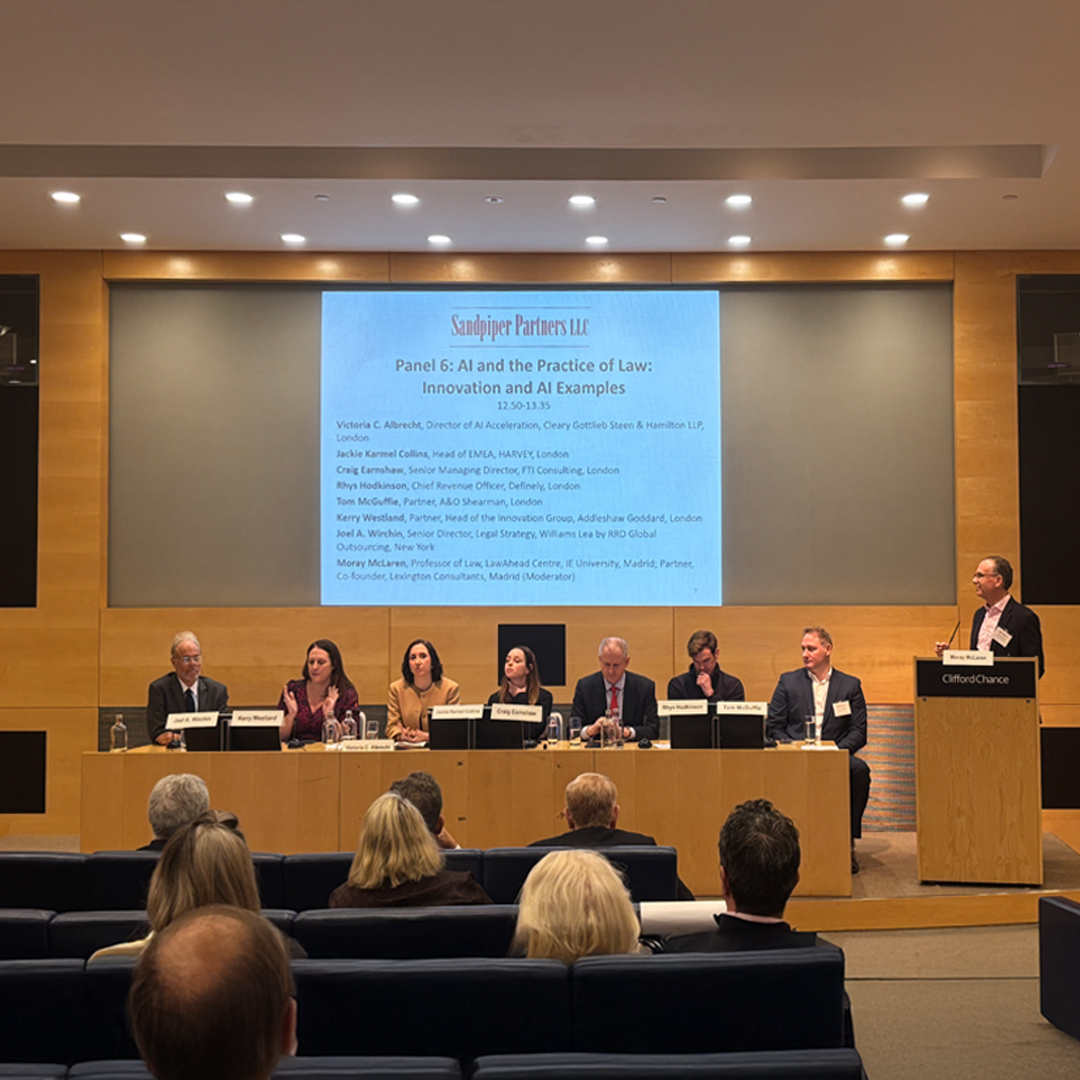
Law firm leaders and their clients gathered in New York City for Sandpiper Partners’ 18th Annual Leading Law Firms conference to discuss the state of the legal market: How firms are managing the pace of change, staying ahead in the war for talent, planning for, and implementing Generative Artificial Intelligence (GenAI), and driving deeper and more meaningful client relationships.
Here are the key takeaways from the event:
Keep calm and counsel on
In the face of what one panelist described as an “overwhelming amount of chaos” brought on by the new administration’s attempts to quickly enact federal agency reform, loosen regulations, and reshape international trade law, the market appears to be somewhat paralyzed. “Everyone expected the year to start with a boom,” said one Managing Partner at a global law firm. “We thought under a conservative administration M&A and deal activity would increase, but we have actually had the worst January for M&A activity in six years.”
The panelists agreed that most clients seem to be “paused” or taking a “wait and see” approach on many initiatives. On the bright side, the chaotic market represents an opportunity for law firms to get closer to their clients. As one panelist remarked, “In response to the flurry of Executive Orders and changes coming down, our level of client engagement is extremely high, especially among multi-national clients.” Leaning into what law firms do best, interpreting regulations and providing advice to clients is critical. Said another law firm leader, “Right now, we are doing a lot of handholding…helping our clients remain calm and briefing them on activities almost in real time.” When the market settles, law firms expect that they will be poised to quickly help clients reignite their strategies.
Shoring up talent during turbulent times
Developing associate talent and managing lateral movements have become critical for the growth strategies of virtually every firm. The panel addressed how their firms are pivoting their talent strategies to address the current market state.
The panelists likened the current environment to the 2008 financial crisis, looking to lessons learned regarding talent acquisition and retention during those challenging times to meet the needs of today’s uncertainty. One panelist described it this way: “The market dynamics are very different than during the 2008 crisis, it’s a much more competitive market there is much less client loyalty. Clients are more likely to follow star talent, which creates a kind of ‘free agent’ market for lawyers.”
Additionally, law firm talent is far more dispersed than before. Between hybrid work styles and increasing digital collaboration, practice teams no longer all go to the same location to work, impacting how firms onboard and cultivate talent.
Many on the panel felt that the in-office/work from home issue had largely been resolved, with Tuesday, Wednesday, and Thursday seeing the most people working in the office, Monday being a lighter day for attendance, and Friday effectively being another Saturday. However, the panel did delve into the consequences of virtual working both in the near and long term. Near term, staying more connected to firm culture will help younger associates truly learn the lessons of navigating tumultuous times. Longer term, one panelist offered up evidence that their firm is seeing that those more willing to spend more time in the office have higher overall retention rates and are advancing at a quicker pace than those who spend more time working virtually.
The panel also discussed the importance of helping first-, second-, and third-year associates turn turmoil into learning experiences. Strategic firms know that even during uncertain periods, they cultivate their rising stars for the long term. Firms are seizing the opportunity to bring in top talent, with several panel members suggesting that their firms are relying on wisdom gained from years of experience to further strengthen their teams in key practice areas and then encouraging partners to help young associates understand how to apply the firm’s values and culture to manage uncertainty.
AI issues for firm leadership
AI has multifaceted implications for law firms. Maintaining profitability while improving efficiency, training lawyers in this evolving environment, and adapting traditional billable hour models, to name a few. Firms are taking multiple approaches to AI adoption, but as one panelist put it, “A lot of testing, but so far no silver bullets…the ROI just isn’t there yet.” The largest impediments revolve around data structure (as so much of law firm data is unstructured), client data usage restrictions, and AI governance.
Said one panelist: “Ultimately, general-purpose legal AI platforms such as Harvey or CoCounsel won’t be what drives transformation. AI imbedded into tools to drive automation and efficiency will have larger impact. There are verticals where AI is functioning better, for example larger litigation activities and tools that focus on specific use cases. Those will be the ones that are more successful.”
Those firms staying on the sidelines of the AI proving ground because they either don’t know how to mitigate the risk or because their firm culture is too resistant to change, do so at their own peril. As a law firm leader put it, “GenAI is starting to be taught in law schools. Firms that are not moving forward with GenAI will fall behind in the competition for talent, for both Associates and Laterals.”
Hillary McNally, Williams Lea’s CRO, added, “Corporations are adopting GenAI faster than law firms, largely due to their leadership mandating AI as a cost efficiency lever. Ultimately, clients will lead the charge and drive their law firms to adopt specific AI tech.”
To bridge the gap between client expectations and law firm technological capabilities, disciplined change management practices need to be considered. As Hillary continued, “How AI tools are implemented, adopted and ultimately optimized will be a service delivery differentiator. For example, at Williams Lea, our process experts, or ‘human-in-the-loop’ teams support AI tool implementation and on-going use, to ensure that ROI is achieved.”
The seamless blend of AI speed and human expertise delivers faster solutions, sharper insights, and client experiences that feel both high-tech and deeply human. Learn more about Williams Lea and the future of AI-powered smart support.


The Think Space
Global law firm leaders are confronting a strategic revolution built on AI and human connection
7 Min Read
The admin support blind spot: Why private equity’s growth hinges on tech-enabled outsourcing
4 Min Read